



cfs = [5, 5, 105]
times    = [1, 2, 3]

discount_rate = 0.03

present_value(discount_rate, cfs, times)           # 105.65
duration(Macaulay(), discount_rate, cfs, times)    #   2.86
duration(discount_rate, cfs, times)                #   2.78
convexity(discount_rate, cfs, times) # 10.62A collection of common functions/manipulations used in Actuarial Calculations.
duration:- Calculate the
Macaulay,Modified, orDV01durations for a set of cashflows - Calculate the
KeyRate(time)(a.k.a.KeyRateZero) duration orKeyRatePar(time)duration
- Calculate the
convexityfor price sensitivity- Flexible interest rate models via the
FinanceModels.jlpackage. internal_rate_of_returnorirrto calculate the IRR given cashflows (including at timepoints like Excel'sXIRR)breakevento calculate the breakeven time for a set of cashflowsaccum_offsetto calculate accumulations like survivorship from a mortality vectorspreadwill calculate the spread needed between two yield curves to equate a set of cashflows
Compute exact key rate durations, DV01s, and convexities using ForwardDiff through ZeroRateCurve from FinanceModels.jl -- machine-precision sensitivities in a single pass, no bump-and-reprice required.
using ActuaryUtilities, FinanceModels, FinanceCore

rates = [0.03, 0.03, 0.03, 0.03, 0.03]
tenors = [1.0, 2.0, 3.0, 4.0, 5.0]
zrc = ZeroRateCurve(rates, tenors)

# Works with amounts + times or Cashflow objects directly
cfs = Cashflow.([5.0, 5.0, 5.0, 5.0, 105.0], tenors)

# All key rate sensitivities in one AD pass
result = sensitivities(zrc, cfs)
result.value       # present value
result.durations   # key rate durations (vector)
result.convexities # cross-convexity matrixsensitivities: bundled value, key rate durations, and convexity matrix in a single AD pass- Two-curve decomposition: separate
IR01(risk-free) andCS01(credit spread) sensitivities - Do-block syntax: custom valuation functions for rate-dependent instruments (callable bonds, floaters, caps/floors)
- Hull-White stochastic model: key rate sensitivities of Monte Carlo expected values, differentiating through the full simulation pipeline
using FinanceModels: ShortRate

hw = ShortRate.HullWhite(0.1, 0.01, zrc)
hw_result = sensitivities(hw, cfs, tenors; n_scenarios=1000, rng=Xoshiro(42))
hw_result.durations   # key rate durations under stochastic dynamics
See the Key Rate Sensitivities documentation for details.
- Calculate risk measures for a given vector of risks:
CTEfor the Conditional Tail ExpectationVaRfor the percentile/Value at RiskWangTransformfor the Wang TransformationProportionalHazardfor proportional hazardsDualPowerfor dual power measure
duration:- Calculate the duration given an issue date and date (a.k.a. policy duration)
- functions which return a rate/yield will return a
FinanceCore.Rateobject. E.g.irr(cashflows)will return aRate(0.05,Periodic(1))instead of just a0.05(float64) to convey the compounding frequency. This is compatible across the JuliaActuary ecosystem and can be used anywhere you would otherwise use a simple floating point rate.
A couple of other notes:
rate(...)will return the scalar rate value from aRatestruct:
julia> r = Rate(0.05,Periodic(1));

julia> rate(r)
0.05- You can still pass a simple floating point rate to various methods. E.g. these two are the same (the default compounding convention is periodic once per period):
discount(0.05,cashflows)

r = Rate(0.05,Periodic(1));
discount(r,cashflows)- convert between rates with:
r = Rate(0.05,Periodic(1));

convert(Periodic(2),  r)   # convert to compounded twice per timestep
convert(Continuous(2),r)   # convert to compounded twice per timestep
For more on Rates, see FinanceCore.jl. FinanceModels.jl also provides a rich and flexible set of yield models to use.
Full documentation is available here.
See JuliaActuary.org for instructions on running this example.
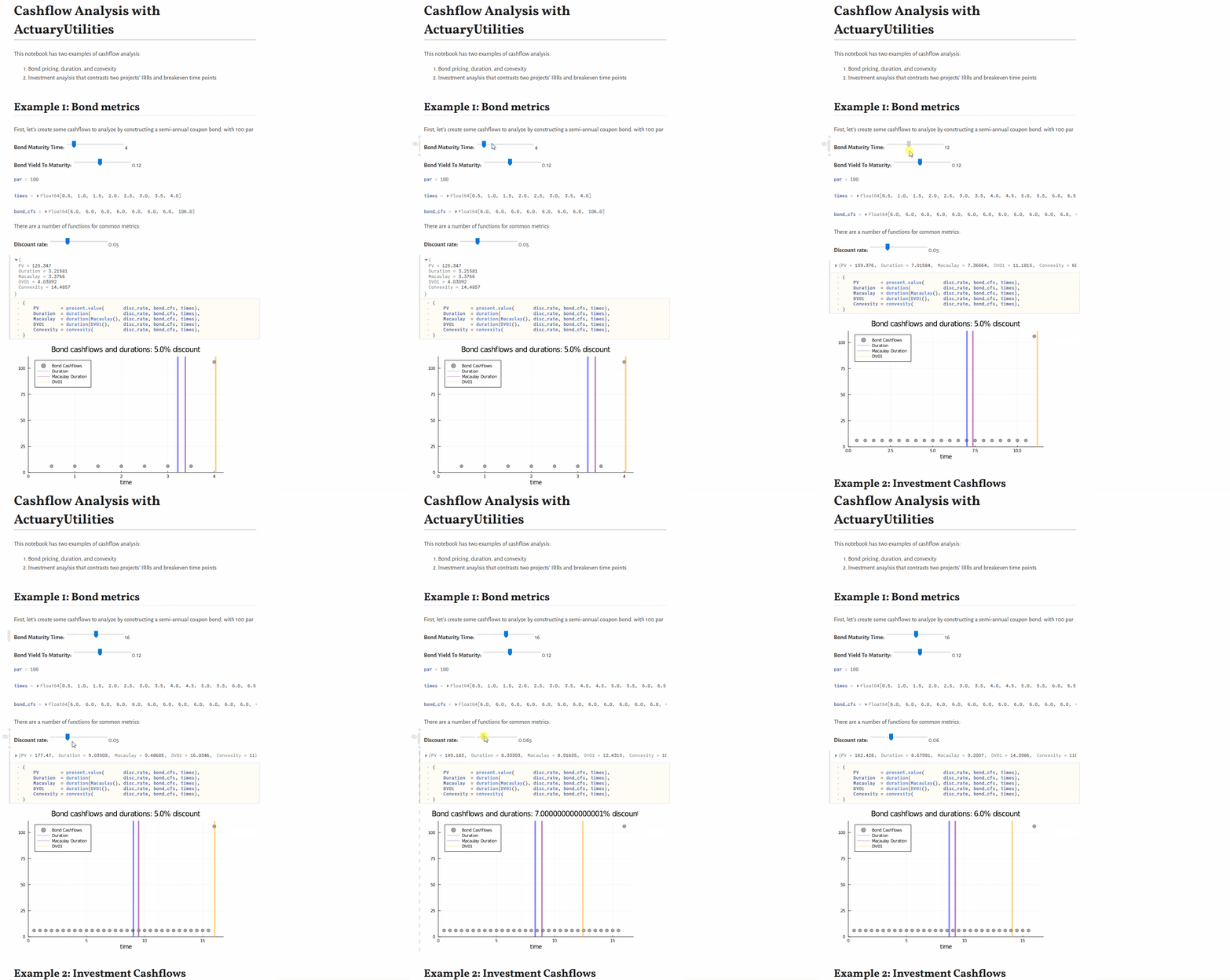
Functions often use a mix of interest_rates, cashflows, and timepoints. When calling functions, the general order of the arguments is 1) interest rates, 2) cashflows, and 3) timepoints.